You are welcome to take part in our prize survey on how our product is used (Chinese)
BrainFrame survey for EN
BrainFrame is a mature AI vision analytics software platform. It is also the first AI system in the industry to adopt algorithm capsule technology (OpenCV adopted the OpenVisionCapsules open standard), letting users configure, download and update the visual deep neural networks in real time according to their business while the system is running. In early 2020 we co-released the solution with OpenCV.org: the BrainFrame platform + vision algorithm capsules.
Built on leading innovative technology and on the ability to recognize and analyze people, vehicles, objects and behavior, the platform comes with a wide range of commonly used AI skills (algorithm capsules) preinstalled, for video surveillance scenarios such as job-conduct management, retail, restaurants, communities/campuses, buildings, smart-city public spaces, transportation, industrial inspection and safe production. These include human detection, people counting, electronic fences, face identity recognition, behavior recognition (smoking, phone calls, falls, running, walking trajectories), detection of hats/glasses, head-down/sleeping/absence detection, vehicle detection and tracking, and traffic flow analysis. Skills can be combined flexibly to fit business needs, making it easy for system integrators and developers to handle all kinds of intelligent video analytics tasks, with support for on-premises and edge computing.
- The open-source vision algorithm capsule standard supports all kinds of neural network training frameworks, such as TensorFlow, OpenCV DNN and OpenVINO. Developers can quickly develop and package new algorithms themselves, or quickly package compatible third-party algorithms. You are not tied to a single algorithm supplier.
- It supports Intel CPUs, integrated GPUs, VPUs and NVIDIA GPUs, and can load custom AI accelerator chips. Computing load is scheduled concurrently across all of the chips' acceleration units, and algorithm fusion is done automatically.
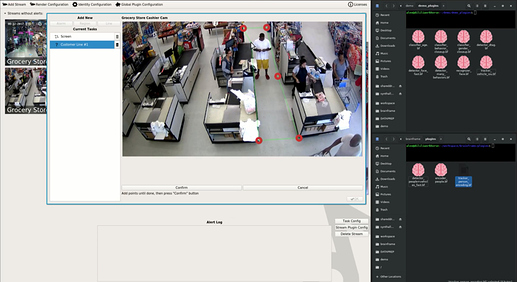
- A management client provides real-time video AI overlays and can be used directly in demos or production. A graphical interface configures camera or video-file input; the mouse sets alert areas and electronic boundaries; alert conditions are set; and Grafana dashboards display and analyze the structured data, producing all kinds of charts and reports.
 Application scenario demos
In a shopping mall, BrainFrame can manage the checkout area, entrances, shelves and warehouses — the number of people in a queue, waiting time, average checkout time, customer gender, whether a customer is a member, and so on.
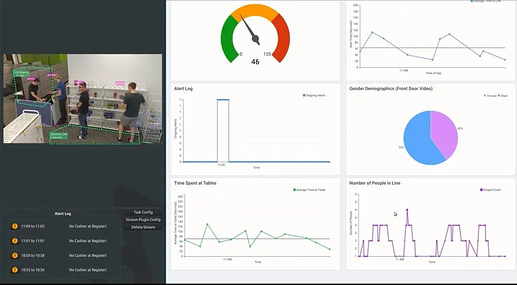
By drawing electronic fences, you set the monitored areas. It detects the number of people in an area, giving you the queue length and waiting time in real time, and uniform detection tells you whether staff are in their work area.
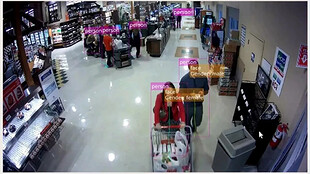
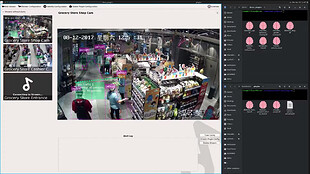
By combining these AI skills flexibly, it produces business management data, overtime warnings, VIP recognition reminders, and shelf and product layout optimization. Knowing foot traffic in different periods and gender/age statistics effectively improves management efficiency and service quality.
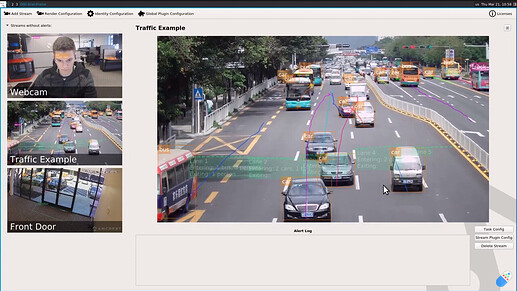
On the road, it analyzes traffic by lane, vehicle type, wrong-way driving, running red lights and motor vehicles illegally using non-motorized lanes, with real-time alerts.
 Industry pain points & platform features
Common problem 1:
The business logic of combined application scenarios is complex, so designing and integrating AI solutions is difficult and takes a long time. Engineers often spend less than 10% of their effort on the AI application for the specific scenario, but more than 90% of their time developing, integrating and deploying the general AI system and application. This is time-consuming and laborious, validation cycles are long, costs are high, it is inflexible, and it may even end up impossible to roll out.
Platform advantage: using this platform has a low barrier, low cost and greatly shortens the development cycle. The client is fully visual, and multiple algorithm capsules are hot-pluggable. Without any AI or algorithm background, you can use the BrainFrame vision AI analytics platform to fuse and schedule capsules automatically, connecting them to one another to form a neural network topology that runs efficiently.
Application engineers no longer need to worry about AI systems engineering. They only need to focus on developing the scenario application, scheduled uniformly through the BrainFrame platform API. Systems deploy quickly, configuration is what-you-see-is-what-you-get, and the application can be verified immediately.
Common problem 2:
The hardware and retrofit costs of a project are high, which makes budget decisions hard and prevents quick adoption. In many industries and enterprises that improve a solution with AI, newly installed smart cameras and other systems are often not compatible with existing ordinary IP cameras and other equipment, causing duplicated investment and huge waste of resources.
Platform advantage: using this platform is fully compatible, flexibly configurable and ready to use once installed. BrainFrame is a pure software solution that supports on-premises or cloud deployment, is compatible with ordinary standard IP cameras and can integrate smart cameras. A different combination of algorithms and alert business logic can be defined flexibly for each video stream, for all kinds of continuous monitoring, tracking, early warning and statistical analysis. Clustered computing can connect multiple sites and support thousands or even millions of camera streams.
Common problem 3:
There are many platforms and algorithms, but each system is independent and relatively closed. Some integrators or applications find that once they integrate with one platform, they can only use the capabilities and algorithms within that platform's framework, which is not compatible with third parties. Being “locked in”, they cannot combine or break through to find the best solution to deliver an application.
Platform advantage: OpenCV promotes an open-source international standard, the OpenVisionCapsules vision algorithm capsule solution. Developers can use the open-source standard code to quickly develop and package new algorithms themselves, or quickly package compatible third-party algorithms, and load them in combination to create entirely new vision applications. It is highly general and compatible, extremely flexible and plug-and-play, with a short development cycle and low cost, and a large number of free algorithm capsules are preinstalled.
[Developers can use it for free and join the discussion, to learn more about the skills and platform features that empower all kinds of industry applications]
 Open platform | Open-source algorithms
Developers can get the free program and open-source code at the links below —

BrainFrame platform free download and installation guide:
https://dilililabs.com/docs/getting_started/
Algorithm capsule download list:
https://dilililabs.com/docs/downloads/#capsules
Algorithm capsule development guide:
https://dilililabs.com/docs/tutorials/capsules/creating_a_basic_capsule/
Open-source code and template examples for algorithm capsules can be downloaded from OpenCV's GitHub:
Algorithm capsule documentation:
https://openvisioncapsules.readthedocs.io/en/latest/
OpenCV.org Hardware Partnership Program
Introduction to OpenCV algorithm capsules
How to design hardware compatible with algorithm capsules:
You can also scan the QR code below to join the WeChat group for product technical and training support. For the group's approval, please note “company_name”.

Contact us: https://dilililabs.com/zh/contact/
Thank you for your support and understanding!
BrainFrame video analytics product team